
Glockenglass
Originally part of an R&D session, I recorded a shot glass filled with water using a Kalimba tuning hammer.

The story
Wow it’s been 2 nearly 3 months. I have been busy with a whole bunch of things. Including a new library I’ve been preparing and hopefully soon we’re gonna start recording it, it’s going to be fun and I can’t wait to release it eventually.
The story behind Glockenglass is a very interesting one, I was approached by one of my composer friends if I could make some “sounds from glass and or milk bottles” for one of his film scores. I said I could try, but there was a couple problems that arose (one of which i solved). The first problem was, I don’t live by myself, I live with family (which consists of my brother, my sister and my dog, at least in my house) and they’d be wondering what I’m doing with the glass and what that noise is lol.
Fortunately I was able to have a moment with myself to actually capture the sounds. The second problem was, the deadline I got given to make the instrument was incredibly tight and I would never be able to do it in a short timeframe without it sounding sloppy, so I decided to decline. A question you may be asking is “if you declined, why didn’t you stop?” I decided to continue on with the development of the library because I actually wanted to have my own glass instrument. if its one thing I’ve learned, there’s something special about making your own instruments and I think it draws more of a personal connection both to your music and the instrument itself, even if general public doesn’t actually pick up on that.
I recorded a variety of glass objects, a glass coffee jar, a shot glass to a glass cola bottle. However only one of these glass objects stood out to me the most and sounded the most useable, which was the shot glass. I don’t drink alcohol btw. The way I approached this was pretty straightforward, I filled the shot glass with water and then I hit the glass gentle enough so it didn’t shatter but enough so I could record 2 dynamic layers, with a kalimba tuning hammer and recorded it on my wonderful Tonor TC-777. The end result sounds similar to a glockenspiel to me (hence the name of the library). At the time this was more of an “R&D” experiment as I was trying to figure out what to do next.
The sound design element of this was a tricky one, because I had no idea what to do, I felt like I’d already done everything and it felt predictable. So I sat on it for a while, and then one day it came to me. I decided to start messing with the built in DecentSampler FX, which I never did much due to the fear of accidentally breaking something. But I overcame that by actually reading the DecentSampler documentation. For the first time I used the actual built in Decent Sampler FX you have to agree for a first time thing its pretty impressive, usually i just make the sound design separate and get the big knob to crossfade between them.
There are 2 dynamic layers and 3 round robins. Those dynamic layers are controlled by velocity!
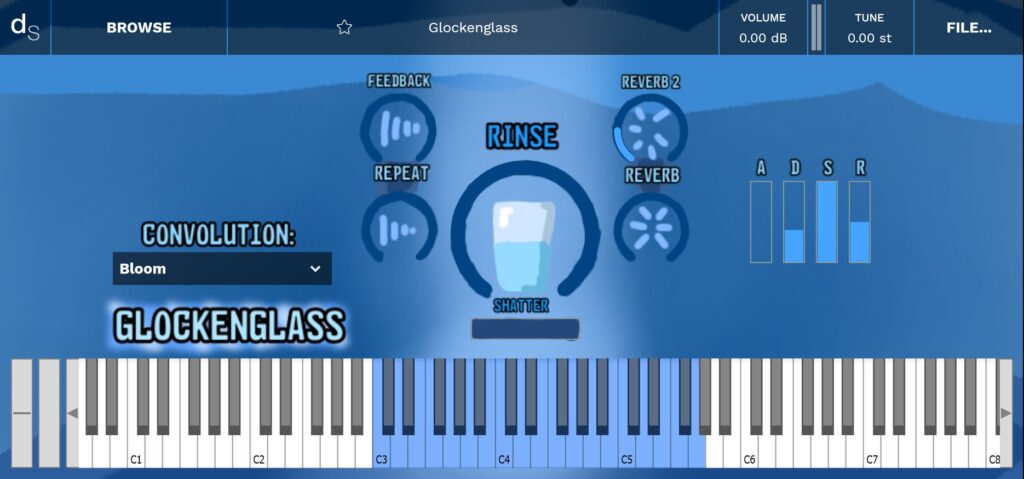
In this library, you have a total of 6 controls:
Repeat – Delay (Syncs to DAW tempo)
Feedback – controls the delay feedback.
Reverb – controls convolution reverb
Reverb 2 – controls an algorithmic reverb (DS built in reverb)
Rinse (Controlled by CC1) – manipulates the sound
Shatter (slider) – manipulates the sound even more
Couple of pointers:
Don’t play this in octaves, it creates an extra harmonic.. for example if you play C in octaves, you get an extra D, however in close voiced chords (eg. triads) it doesn’t have that effect.
Don’t go too overboard with shatter as it can get loud, especially with the bloom convolution. In fact don’t go too crazy with Bloom twofold lol.
ADSR is included, however I recommend using attack is small doses as it can quieten the sound, only use it if you want to soften the notes.
You can view the overview (its a masterpiece of a video lol) here:
Other than that, have fun :p
Interface
Reviews
By Mark (Nowa) Taylor
Hello, I make music primarily and as a side hobby I develop virtual instruments. I've been making libraries since 2024 and the goals I have for this profile are...