
Bamboo Chimes Piano
Koshi windchimes are bamboo cylinders with metal rods inside, triggered by a small glassdisc. This "piano" tries to catch the sound with some added special features.

The story
When I first heard the so called Koshi Wind Chimes, I immediately fell in love with the sound. On the one hand there’s the brilliant short attack from this little glasdisc on a string, which triggers the metal rods inside a bamboo cylinder moved by the wind. On the other hand there’s this following hovering warm tone.
There are eight rods which are tuned to a special scale or chord. So it doesn’t matter, which rods are triggered by the wind. It always sounds wonderful. For instance, my version of the windchimes is tuned a – d – f – g – a – d – f – a. So it’s basically a d-minor chord but with an added g in the middle. The Bamboo Chimes Piano is of course chromatic. So you can play whatever you want.
To trigger the rods in order to record them I was unfortunately unable to use the original glasdisk inside the cylinder. It is not really possible to move the string so that the glas beats only that rod you want. So instead I took a drinking straw made out of glas. I found, it sounds very similar.
The notes I recorded with a Rode Nt1a directly into my Focusrite Scarlett interface. I made five recordings of each note to get a round robin mode at the end. Additionally I panned each layer (group) slightly different to left and right. Only a little bit. I think it gives the instrument a more natural sound and openness.
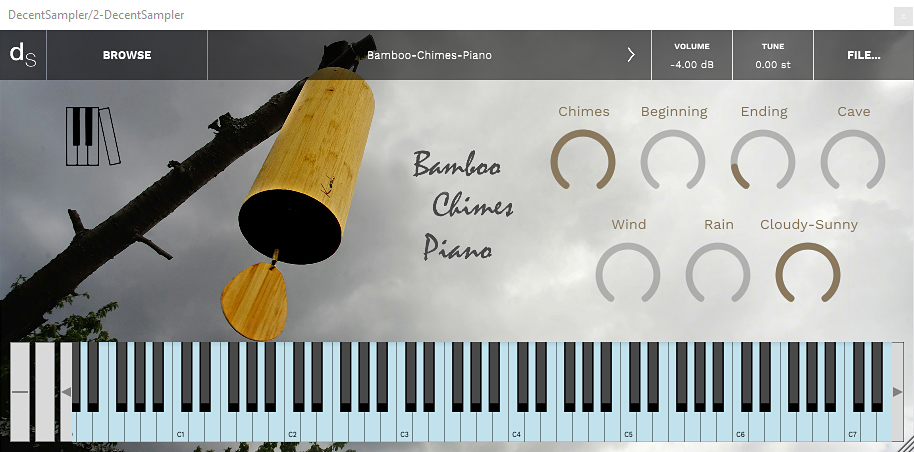
Furthermore I gave the instrument some possibilities to change its character with the following features:
Chimes: This is simply the volume of the triggered rods
Beginning: This changes the attacktime from short or direct to smooth
Ending: This changes the releasetime
With Cave you can add some reverb to the sound
Wind adds clean reverse played notes
Rain: Here you can add reverse played notes manipulated by a slightly overdriven, fluttering tape-simulation, which gives the sound much more liveliness and first of all more texture .
By the way: The Chimes-knob doesn’t affect the Wind- and Rain-Level. So you can play only reverse-notes if you want, turning the Chimes-knob fully to the left.
Last but not least there’s a knob called Cloudy-Sunny: This is simply a lowpassfilter. Fully clockwise you can hear the direct and bright original sound. Counterclockwise the sound get’s darker, muddier just cloudy.
That’s it for my first instrument. Maybe you will enjoy it and have some fun.
Thank you
Wiesental
Bamboo Chimes Piano
Interface
Reviews
Wow, I am totally floored!
This is a really well -done sample pack of an instrument that is not easy to record but one that sounds so beautiful!
My dream came true when I stumbled upon this while searching the Internet for precisely this sound.
I actually used the samples in one of my tunes! So, thank you for the pack and for inspiring me!Please sample all the Koshi Wind Chimes <3
Realy fantastic to find your work Wiesental. I was hoping and almost mailing Spitfire Audio to sample all these Koshi Wind Chimes, would love to have them all ;-) How you did it sounds really good <3
Perfect
amazing sound with great bass..................................................................................................

By Wiesental
To make my living, I'm a journalist. To make me happy, I make music. Especially I like electronic, experimental and ambient sounds. But sometimes I take my...